
Rwanda is often presented as one of Africa’s leading financial inclusion success stories, and with good reason. The 2024 FinScope survey found that 96% of adults are financially included, 92% are formally served, and 77% hold a transactional account through channels such as mobile money or banks. Yet one of the most important lessons from Rwanda’s progress is that inclusion has not happened through formal finance alone. Informal and community-based mechanisms, especially Village Savings and Loan Associations, remain central to how millions of people actually save, borrow, cope with shocks, and invest in their futures.
Concern Worldwide describes VSLAs as member-run groups that help people living in poverty build savings, access small loans, and strengthen community cohesion. In Rwanda, their significance is even deeper: they provide households with a practical, trusted, and flexible financial tool in settings where incomes are seasonal, emergencies are frequent, and formal products do not always match daily reality.
Why VSLAs Still Matter in a Country with High Financial Inclusion
A common mistake in financial inclusion analysis is to assume that as formal access rises, community finance becomes less relevant. Rwanda shows the opposite. FinScope 2024 reports that informal mechanisms remain widely used, even as formal inclusion has expanded sharply. This means the country’s financial deepening is not replacing community finance; it is happening alongside it. VSLAs remain embedded because they solve a different problem: not simply access, but usable finance at household level.
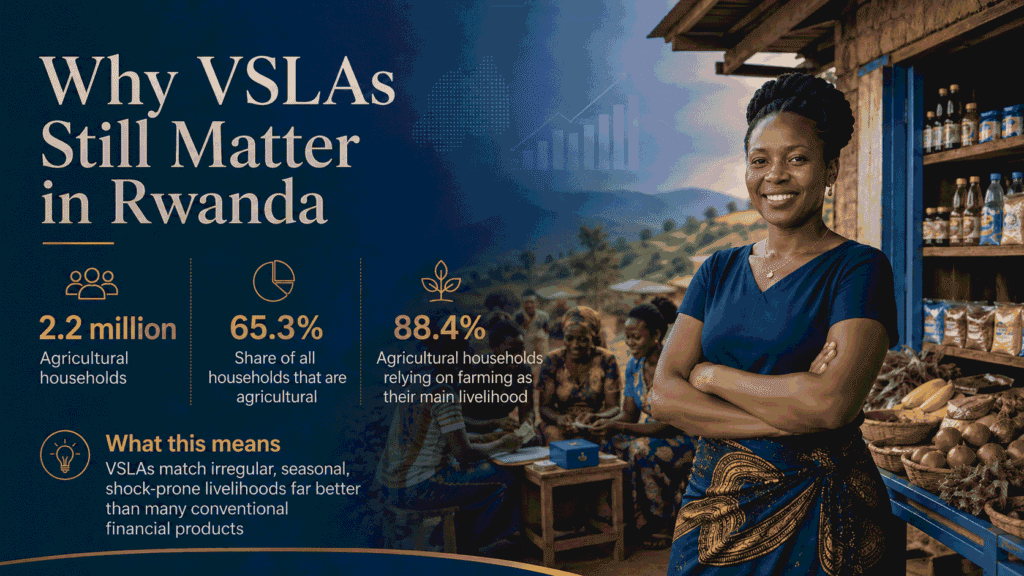
This matters especially in Rwanda’s rural economy. The 2024 Agricultural Household Survey estimates 2.2 million agricultural households, representing 65.3% of all households nationwide, and reports that 88.4% of agricultural households rely on agriculture as their main livelihood activity. In such conditions, a bank account alone does not guarantee resilience. Households need mechanisms that help them save in small amounts, borrow quickly, manage shocks, and maintain social accountability. VSLAs do exactly that.
VSLAs Are Not Only About Inclusion. They Change How Households Live.
The real value of a VSLA is not captured by membership numbers alone. Its deeper contribution lies in how it changes household behavior. VSLAs help families convert irregular income into disciplined saving. They reduce dependence on distress sales of assets. They create a source of small working capital for petty trade, livestock, agricultural inputs, and other livelihood activities. They also provide emergency liquidity for school fees, medical care, and unexpected expenses. In development terms, this means VSLAs often improve resilience before they visibly increase income.
The Rwanda BIFSIR thematic brief makes this concrete. It describes VSLAs as an entry point into wider financial service use and reports that, with programme support, 535 new VSLAs were formed with 14,903 members, 70% of them women, alongside a 90% loan repayment rate and 15,754 people reached with financial education. It also presents a case from Gatsibo in which VSLA participation enabled a member household to increase retail stock, cover family expenses, secure health insurance, acquire land, and plan house construction. That is the livelihood story in one example: VSLAs do not only move people into finance; they move households from short-term coping toward medium-term planning.
Women’s Economic Agency Is One of the Strongest VSLA Effects
VSLAs are especially significant for women. Rwanda’s 2024 Gender and Financial Inclusion Thematic Report shows that overall financial inclusion is now very high for both women and men, at around 96% and 97% respectively. But the same report also shows an important structural gap: only 17% of women hold bank accounts, compared with 27% of men. At the same time, savings groups remain especially important for women, including rural women. This reveals something important: women are included in finance, but a large share of that inclusion is still happening through informal and community-based systems rather than through banking.
That distinction is crucial for policy and programme design. When women are financially included mainly through savings groups and mobile channels, but less through higher-value formal products, then inclusion has expanded but empowerment may still be uneven. VSLAs can help close that gap by strengthening saving discipline, investment confidence, peer learning, and decision-making power at household level. They are not the endpoint of women’s economic empowerment. They are often the platform from which deeper economic agency can be built.
Timeline Heading 1
This is timeline description. Please click here to change this description.
Timeline Heading 2
This is timeline description. Please click here to change this description.
Timeline Heading 3
This is timeline description. Please click here to change this description.
Timeline Heading 4
This is timeline description. Please click here to change this description.
Timeline Heading 5
This is timeline description. Please click here to change this description.
The Next Frontier Is Linkage, Not Replacement
The strongest financial inclusion model in Rwanda is no longer “informal versus formal.” It is “informal linked to formal.” The National Financial Inclusion Roadmap 2026–2030 states that while Rwanda is approaching universal access, meaningful usage remains relatively low, and the share of banked adults has stagnated at 22% since 2020. The roadmap explicitly marks a shift from access toward impact and financial health. That is a strong policy signal: the next phase is not only about expanding access, but about making financial lives deeper, more useful, and more resilient.
This is where VSLAs become strategically important. Well-designed VSLA programmes can act as a ladder. First, they help households save and borrow safely. Then, they can be linked to mobile money, SACCOs, microinsurance, digital records, and eventually enterprise finance for more mature members. Without those linkages, VSLAs may stabilise poor households but leave them confined to low-value financial cycles. With them, VSLAs can become launchpads for broader local economic transformation. This inference is grounded in Rwanda’s current policy emphasis on usage, financial health, and resilience.
What Serious Clients Should Learn from the Rwanda Experience
For funders, NGOs, financial service providers, and government actors, the Rwanda case offers an important lesson: counting groups is no longer enough. What matters now is what those groups are changing. Are they increasing women’s control over income? Are members using loans for productive investment or only for crisis management? Are groups linked to formal products? Are they improving resilience to health, education, and climate shocks? Are they changing enterprise survival, food security, or asset accumulation?
These are no longer secondary questions. They are the difference between basic outreach and real livelihood transformation. In Rwanda, where access is already high, the real frontier is the quality, depth, and developmental value of financial inclusion.
Our Perspective
At Lambda Research and Learning Advisors, we view VSLAs not simply as grassroots savings mechanisms but as measurable systems of financial behaviour change, resilience-building, and livelihood transition. For organisations working in financial inclusion, women’s economic empowerment, rural development, youth livelihoods, or social protection, the key challenge is not only whether VSLAs exist. It is whether they are producing durable outcomes: stronger household resilience, women’s economic agency, enterprise growth, improved service linkage, and more inclusive local economies.
This is where rigorous evidence matters. Lambda’s value lies in helping clients move beyond surface metrics to decision-grade insight: mixed-methods assessments, gender-responsive analysis, livelihood pathway evaluation, financial inclusion diagnostics, and learning products that show not only whether a programme worked, but how it worked, for whom, and what should happen next. In a country like Rwanda, where inclusion is already high but inequality of use and opportunity still matters, that kind of analysis separates visible programmes from transformative ones.
