
Artificial intelligence (AI) is rapidly transforming economies, governance systems, and public services across the globe. From predictive health analytics to automated financial systems, AI promises efficiency, innovation, and accelerated development. For many high-income countries, it represents the next frontier of productivity and growth.
Yet this transformation is unfolding within a deeply unequal global system. Differences in infrastructure, data access, institutional capacity, and human capital mean that AI does not affect all countries equally. Instead, it risks reinforcing—and in some cases widening -the gap between those who can leverage it and those who cannot.
The central question is no longer whether AI will shape development -but how it is reshaping inequality, and for whom.
1. The Emergence of a New Digital Divide
The traditional digital divide is evolving into something more structural: the AI divide.
This divide is driven by three core asymmetries:
- Computational power concentrated in a few countries and corporations
- Data ownership largely external to low-income contexts
- Technical expertise clustered in high-income economies
Countries without strong digital ecosystems are entering the AI era from a position of disadvantage. As a result, innovation and productivity gains are increasingly concentrated where systems already exist.
2. Productivity Gains—and Unequal Economic Returns
AI is transforming productivity across sectors -enhancing efficiency, automating complex processes, and creating new economic opportunities.
However, these gains are unevenly distributed.
In many low- and middle-income countries:
- Employment remains largely informal and low-skilled
- Digital infrastructure is limited
- Participation in global value chains is constrained
This creates a structural imbalance:
AI increases global productivity, but not global equity.
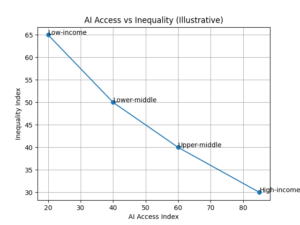
Figure 1: Relationship between AI access and inequality across income groups (illustrative).
Interpretation:
The figure shows a clear inverse relationship between AI access and inequality. Countries with higher levels of AI access tend to experience lower structural inequality, while those with limited access face higher inequality. This suggests that AI is not simply a neutral tool -it amplifies existing structural advantages.
3. Data Inequality and the Rise of “Data Colonialism”
At the heart of AI lies data. Yet global data flows are highly unequal:
- Data is often generated in low-income contexts
- It is processed and monetised elsewhere
- Benefits rarely return proportionally to the source
This dynamic has led to the concept of data colonialism –where data becomes a resource extracted without equitable value sharing.
At the same time, many AI systems are trained on datasets that underrepresent African and low-income contexts, leading to:
- Algorithmic bias
- Reduced local relevance
- Lower performance in real-world applications
This creates a system where some populations are visible to AI—and others are not.
4. Public Services: Opportunity or Risk?
AI has the potential to transform public services:
- Predictive healthcare systems
- Adaptive learning platforms
- Climate-smart agricultural tools
However, without inclusive design, these systems risk:
- Prioritising populations with better data
- Excluding marginalised communities
- Reinforcing existing service inequalities
AI can either reduce inequality or deepen it depending on how it is governed.
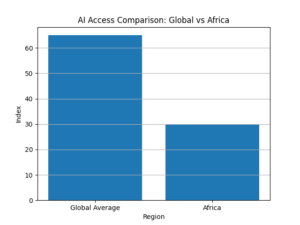
Figure 2: Comparative AI access and data availability between Africa and global averages (illustrative).
Interpretation:
Africa lags significantly behind global averages in both AI access and data availability. This reflects broader structural challenges in infrastructure, investment, and digital ecosystems. Without targeted efforts, this gap risks excluding African economies from the most transformative benefits of AI.
5. Governance Gaps and the Risk of Exclusion
AI governance remains uneven globally. While high-income countries are advancing regulatory frameworks, many low-income countries face:
- Limited regulatory capacity
- Weak data protection systems
- Dependence on external technologies
This creates a governance imbalance where decisions affecting developing countries are often made elsewhere, limiting local ownership and accountability.
6. Can AI Become an Equaliser?
Despite these risks, AI holds significant potential—if deployed inclusively.
To ensure AI contributes to reducing inequality, five priorities are critical:
1. Digital Public Infrastructure
Invest in connectivity, platforms, and interoperable systems.
2. Local Data Ecosystems
Ensure data is generated, governed, and used locally.
3. Skills and Capacity
Develop local expertise in AI, data science, and policy.
4. Inclusive Governance
Strengthen regulatory frameworks to ensure ethical and equitable use.
5. Equitable Partnerships
Shift from extractive models to co-creation and shared value.
🔍 Key Insight
AI is not neutral. It amplifies existing advantages.
Countries with data, infrastructure, and skills accelerate ahead -while others risk falling further behind.
Artificial intelligence is more than a technological shift -it is a structural force shaping the future of development.
Its impact will depend not only on innovation, but on choices:
- Who controls data
- Who builds systems
- Who benefits from their outputs
If current trends continue, AI risks embedding inequality into the very systems meant to drive progress. But with deliberate investment, inclusive governance, and equitable partnerships, it can instead become a powerful tool for shared development.
The challenge for development actors is clear:
move beyond adopting AI -and begin shaping it.
